
Hardin County Release Types
A person can leave the Hardin County Jail without being free from government custody. Community release may follow a bond or pretrial order, completion of a local sentence, dismissal, or another court command. A transfer sends the person to IDOC, another county, a federal agency, a hospital, or another authorized custodian. The sheriff’s record should distinguish these events. Ask for the date, time, legal authority, release type, and destination rather than relying on the fact that a name vanished from a roster.
Pretrial release means the criminal case continues while the person lives outside the jail under any conditions set by the court. Time served means the custodial part of a sentence has been met, though another warrant or hold may still control. Parole or mandatory supervised release, called MSR in Illinois, means prison confinement ended but state supervision did not. Final discharge means the sentence and supervision ended. Death ends custody but is not a release, and a transfer is never a community release.
| Event | What it means | Best next record |
|---|---|---|
| Bond or pretrial release | The case continues outside jail, often with conditions. | Court order and sheriff release time |
| Time served or discharge | The ordered local custody term ended. | Sentence, credit calculation, and jail record |
| Parole or MSR | Prison confinement ended; IDOC supervision continues. | IDOC status and projected discharge |
| Transfer | Custody continues with another agency. | Receiving agency and admission record |
| Dismissal or acquittal | That case may no longer support detention. | Court disposition plus hold check |
Hardin Release Record Fields
A sound release record answers five points: who left, which custodian the person left, when the event occurred, whose authority controlled it, and where the person went. The 2022 IDOC inspection checklist supplies useful request targets for the Hardin jail. Because its scanned check marks are not always clear, those items are standards to request, not a promise that every person’s file contains each item.
| Field | What it shows |
|---|---|
| Name, birth date, booking number | Distinguishes the person and ties the event to the correct booking. |
| Admission and release date/time | Builds the physical custody timeline. |
| Authority and release type | Identifies the order, bond, sentence completion, or transfer basis. |
| Destination or receiving agency | Separates community release from continued custody. |
| Case, judge, and disposition | Connects jail action to the court record. |
| Property and medication records | Documents returned items and maintenance-medication handling. |
| Booking photograph | Helps match the booking but proves neither guilt nor release. |
Supporting documents can include the bond or pretrial order, sentence calculation, identity check, physical inspection, transfer paperwork, and signed property receipt. Preserve the agency’s exact description of the event. A label such as “released to IDOC” describes a transfer into state custody, while “released on recognizance” describes a court-authorized return to the community.
Request Hardin Release Records
No verified Hardin County online release archive was located as of the research date. The practical source is the Hardin County Sheriff/Jail at 104 E. Market Street, P.O. Box 246, Elizabethtown, Illinois 62931, 618-287-2271. Start with a narrow, purpose-neutral request. Illinois FOIA normally gives a public body five business days to respond, subject to a permitted five-business-day extension. A response may produce records, cite an exemption, ask for clarification, or explain that no responsive record was found.
- Identify the person by full name, birth date if known, booking number, and a tight date range.
- Ask for the booking and release or transfer event, including date, time, authority, type, destination, and originating county.
- Request the court order, property receipt, medication record, booking photograph, or sentence calculation only when relevant.
- Ask for electronic records in their native form. If an exemption applies, request the nonexempt portion and the specific legal basis.
- Compare the result with the court docket or receiving agency before describing the event as community release.
Under Illinois FOIA fee rules, the first 50 black-and-white letter or legal pages are free, later pages may cost up to 15 cents each, and electronic copies generally carry only the actual cost of the recording medium. Certification may carry a statutory fee. Commercial-request rules differ, but a personal custody-status inquiry should state its real, noncommercial purpose.
Hardin Release Record Access
Illinois FOIA provides the request process, while section 2.15 addresses prompt access to specified arrest information. Its separate 72-hour rule concerns arrest-report information, not a promise that Hardin publishes a rolling three-day release list. Jail files can also be subject to privacy, safety, medical, juvenile, sealed-record, and law-enforcement exemptions. Agencies should identify the exemption used and release reasonably separable public material.
Web visibility and official retention are not the same. Hardin has no verified public roster whose removal schedule can be measured. The underlying booking and release file may remain in a jail system, paper file, permanent log, or archive until an approved retention schedule permits disposal. Ask where the record is held and whether it migrated to an archive. A court docket can remain a useful historical index after a short jail stay.
Sealing limits public access to a record; expungement generally removes or destroys eligible records under a court order. Eligibility and effect depend on 20 ILCS 2630/5.2 and the specific case. An old copy elsewhere does not override the court’s order. Requests should not seek juvenile, sealed, or expunged material that the agency cannot lawfully disclose.
Hardin Release Property Records
The Hardin inspection standards make property documentation a useful release-record target. They call for an inventory return and a signed, itemized property receipt retained as a permanent record. A dispute about missing money, clothing, identification, or another item should name the booking, the item, and the release or transfer time. Request both the intake inventory and signed return receipt so the two can be compared.
Maintenance-medication documentation is another precise target. The inspection material supports asking for the medication-handling record, but it does not prove what happened in any one case. Medical privacy rules may limit release. The person concerned or an authorized representative may need to use the agency’s medical-record process. Pair the request with the event timestamp because a transfer may place later responsibility with a receiving agency.
Search Hardin County Releases
Start with the custody system most likely to hold the event. For a recent Hardin booking, call the jail and ask whether the person is held, released to the community, or transferred. Then search the Hardin case docket. If the answer is “sent to DOC,” move to IDOC. Use VINE as a second current-status channel and for change alerts. Federal or immigration locators apply only when the record points to those systems.
- Confirm identity with a birth date, booking number, court case, or agency number.
- Obtain the sheriff’s actual release or transfer time and destination.
- Read the court’s bond, custody, dismissal, sentencing, or mittimus entry. A mittimus is the order committing a person to custody.
- Follow a transfer into the receiving county, IDOC, BOP, ICE, or USMS record system.
- Mark gaps as unconfirmed. A matching name or an absent roster result is not enough.
Hardin Court and Jail Records
Hardin County participates in Judici’s public court search even though no official sheriff release feed was found. Search by name or case number, then read the docket in date order. Bond and pretrial orders, judgments, sentence entries, custody credit, dismissal, warrants, and later sealing events can explain why a person should leave custody. A future hearing date does not establish release.
The court order and jail execution record perform different jobs. The judge supplies legal authority. The jail logs the physical event, time, and destination. If an online entry is unclear, the Hardin County Circuit Clerk can supply the public order or docket entry. The official court source shown below helps identify the clerk and probation contacts; it does not replace the sheriff’s release timestamp.
The Illinois Second Judicial Circuit Hardin page is captured in the project image.
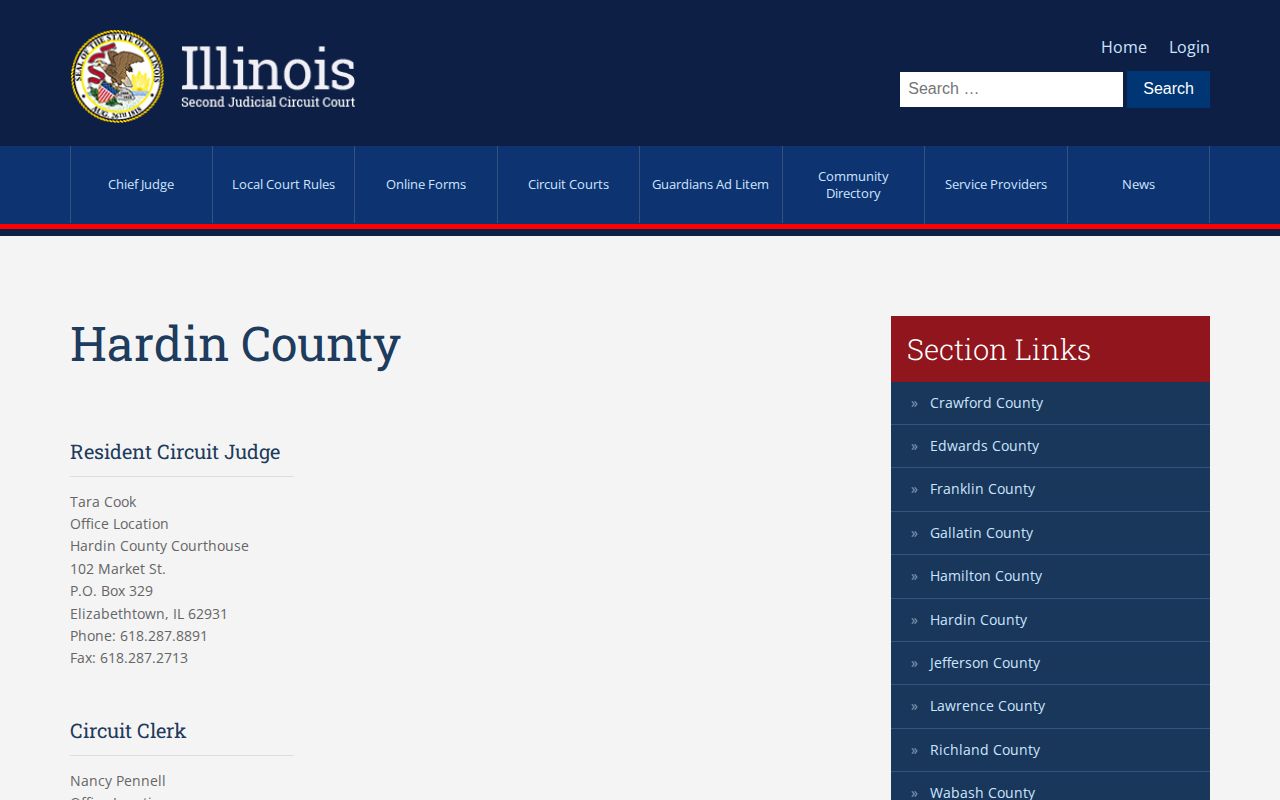
Use the official page to confirm the current court office details, then match its order to the sheriff’s completed release or transfer entry.
IDOC Hardin Release Search
The Illinois Department of Corrections Individual in Custody Search applies after commitment to IDOC. An IDOC number is the strongest search key; name and birth date help when the number is unknown. A matching detail page may show parent institution, offender status, current location, admission data, projected parole or MSR date, parole date, projected discharge date, sentence rows, and whether each sentence is discharged.
| Field | How to read it |
|---|---|
| Offender Status | Distinguishes incarceration from parole or another listed state status. |
| Location | May name a prison or parole district. |
| Parole/MSR Date | Marks or projects prison exit into supervision. |
| Projected Discharge | Estimates the end of sentence and supervision. |
| Sentence Discharged? | Must be checked across all sentence rows. |
Read those fields together. “PAROLE” with a parole district and a future projected discharge confirms release from prison into supervision, not final discharge. IDOC says the public search covers people currently incarcerated or on parole. Once the sentence is complete, the person drops from public results and an archived record must be requested through the IDOC contact form by choosing “Record Search.” No result can also reflect a spelling error or a person who never entered IDOC.
Hardin Pretrial Release Status
Hardin has a specifically assigned Office of Statewide Pretrial Services officer, Faon Crystal, at 618-837-8058. That office can help distinguish release under pretrial conditions from completion of a sentence. Pretrial services does not make the person an IDOC parolee, and the pending case remains active unless the court later disposes of it.
Use the court order to identify the legal conditions and the sheriff record to confirm when processing ended. Electronic monitoring, reporting, travel limits, or other conditions should be described only when the actual order states them. Probation begins from a sentence, while pretrial supervision occurs before disposition. IDOC parole or MSR follows a prison commitment. Calling the office tied to the documented status prevents a person from being routed among three unrelated supervision systems.
Hardin Post-Release Verification
Local probation, statewide pretrial services, and IDOC parole/MSR serve different legal stages. Probation is a court sentence served in the community. Parole and MSR follow prison confinement under IDOC supervision, with the Prisoner Review Board setting conditions and deciding alleged violations. A revocation can return a person to custody and change the next release date. Final discharge ends the remaining sentence or supervision authority.
Illinois VINE offers a second channel for custody changes. Search the specific person, confirm the reporting agency and identifiers, and read the exact status phrase and last update. Registration may support phone, text, email, or app alerts. Phone enrollment uses a private four-digit PIN. VINE can report release, transfer, escape, or court events, but it is not a certified release document and no result does not prove release.
- Detainer
- A request or authority that can keep a person held for another agency.
- MSR
- Mandatory supervised release after Illinois prison confinement.
- Probation
- A court sentence supervised in the community rather than IDOC parole.
- Final discharge
- The end of the sentence and its supervision, not merely prison exit.
Hardin Release Recovery Contacts
The 2022 inspection recorded Arrowleaf as the jail’s mental-health provider and noted peer addiction counseling on request. The Hardin-Pope County ROSC Council adds a regional recovery-navigation path. These are documented service leads, not promises that a specific program, bed, counselor, or appointment is available today.
Confirm current eligibility, intake method, service area, and timing before making plans. Release from the jail does not ensure immediate placement or medication access. A person leaving on pretrial conditions, probation, or MSR should also check whether the court or supervising agency requires a particular provider or approval. Records requests for care should remain limited to what the person or authorized representative may lawfully obtain.
Transportation After Hardin Release
The Illinois Courts directory lists “Rides Public Transit” at the Hardin County Courthouse and notes free parking beside the courthouse. That is a rural trip-planning lead, not evidence of a fixed jail stop, release shuttle, pickup area, or same-day ride. Contact both Rides and the jail before arranging pickup.
Release times can change while staff verify identity, property, orders, holds, and destination. Do not assume courthouse transport aligns with jail processing. Ask where pickup is allowed, whether the person is leaving for the community, and which agency will make the transfer if custody continues. A court order may authorize release before the jail can give a final physical exit time.
Hardin Regional Custody Transfers
The Hardin jail has six beds and, in the 2022 inspection snapshot, could hold Pope and Gallatin County detainees when needed. Facility name alone therefore does not identify the arresting or prosecuting county. A person’s departure can be a return to another county rather than a release to the community.
Every focused request should ask for the originating agency, committing county, destination, release or transfer authority, and exact time. Continue the timeline with the receiving agency. This guards against combining two same-name records or treating a regional movement as freedom from custody. The inspection is dated evidence, so present housing arrangements should be confirmed with the sheriff.
Former Hardin Work Camp Records
Hardin’s custody footprint includes a 1940 county jail and the inactive Former Hardin County Work Camp at Cave-In-Rock. Old directories can make the work camp appear to be a current IDOC release source. It is not. The Illinois State Fire Marshal record marks the site former or inactive, and historical accounts indicate that occupants at closure were candidates for transfer to other IDOC institutions.
Questions about a former occupant belong with IDOC records or Illinois archives. Search the current IDOC system only if the person is still incarcerated or on parole; use the archived-record route after sentence completion. Do not call the Hardin jail for a work-camp discharge unless a separate county booking links the person to the jail.
Federal and ICE Release Records
A federal case belongs in the BOP Inmate Locator and federal court docket. A BOP result may state “Released” with a date or “Not in BOP custody,” but neither describes release from the Hardin jail. More detail or an older result may require BOP FOIA. A USMS transfer is traced through the federal district and USMS records rather than a county-style release archive.
When a Hardin record names ICE, use the ICE Online Detainee Locator for current civil immigration custody and contact Enforcement and Removal Operations for follow-up. Leaving the county jail under an immigration detainer is a transfer, not proof of community release. No official ICE detention facility in Hardin County was found in the research sweep.
Where Hardin Records Appear
The record source depends on the person’s last confirmed custodian. Build a timeline instead of treating any single lookup as a complete history.
| Situation | Primary source | Key caution |
|---|---|---|
| Recent county booking | Hardin Sheriff and Judici | No verified public release feed exists. |
| State prison or MSR | IDOC and VINE | Completed sentences drop from the public IDOC search. |
| Federal sentence | BOP locator and federal docket | A BOP date is not a county release date. |
| ICE custody | ICE locator and ERO | Jail departure may be a custodial transfer. |
| Old local event | FOIA request and court record | Online absence says nothing about retention. |
Hardin Release Record Facilities
The five facility paths cover local, historical, state, federal, and immigration custody. Each answers a different part of a release timeline.
- Hardin County Jail records local community releases and transfers.
- Former Hardin County Work Camp is an inactive historical IDOC site.
- IDOC facilities statewide hold state commitments and supply parole/MSR records.
- Federal Bureau of Prisons facilities nationwide supply federal custody and release results.
- ICE detention network supplies current immigration-custody paths.