
IDOC Statewide Release Paths
A Hardin County defendant sentenced to IDOC can be placed at a suitable prison anywhere in Illinois. No state prison is located in Hardin County, and no nearby institution should be assumed. Classification, sentence, capacity, health, programming, and agency authority affect placement. The Hardin court commitment and sheriff transfer record connect the local case to the state record.
Leaving the Hardin County Jail for IDOC is not release. It is a transfer into state prison custody. Later departure from prison to parole or mandatory supervised release, called MSR, is release from confinement but not final discharge. The person stays under IDOC legal jurisdiction until the sentence and supervision end.
| Status | Custody meaning | Best source |
|---|---|---|
| Incarcerated | Held in an IDOC institution | IDOC live search |
| Parole or MSR | Out of prison under supervision | IDOC profile and Parole Division |
| Final discharge | State sentence jurisdiction ended | IDOC archive or PRB record |
| No result | Ambiguous, including completed sentence | Archive search and identifiers |
Search IDOC Release Status
The official tool is the IDOC Individual in Custody Search. An IDOC number is the strongest input because it reduces same-name errors. Name and birth information can be used when the number is unknown. Try prior or legal spellings and compare offense, commitment county, and physical identifiers before accepting a match.
- Search by IDOC number when available. Otherwise enter the name and birth data offered by the form.
- Confirm the IDOC number, name, parent institution, offender status, location, and Hardin committing-county link.
- Read the exact admission, parole, projected discharge, and sentence-row labels. Do not rename every date “release date.”
- Record the date searched. Projected dates and status can change after credits, court action, detainers, or revocation.
- Save the official result, then use VINE or IDOC records for corroboration when the event matters.
IDOC Release Search Fields
The IDOC detail layout contains fields that must be interpreted together. Its header can show IDOC number, name, Parent Institution, Offender Status, and Location. A person on parole may still have a parent institution listed while the current location is a parole district. That does not mean the person remains inside that prison.
| Official field | How to read it |
|---|---|
| Offender Status | Top-level prison or parole state |
| Location | Institution or supervision unit |
| Admission Date | Start of the IDOC admission |
| Projected Parole Date | Estimated prison-to-supervision point |
| Parole Date / Last Paroled Date | Recorded parole event |
| Projected Discharge Date | Estimated end of sentence jurisdiction |
| Sentence Discharged? YES/NO | Status of each sentence row |
One sentence row may say YES while another says NO. Read every row with the top-level status. Sentence columns can include mittimus, class, count, offense, custody date, sentence, county, and discharge flag. A registration notation may also appear where applicable.
Archived IDOC Discharge Records
IDOC's FAQ says the public search covers people currently incarcerated or on parole. After the whole sentence is completed, the person no longer displays. Therefore no result does not prove that a person was never in IDOC or that no release record exists.
The IDOC FAQ and archive guidance explains this completed-sentence limitation.
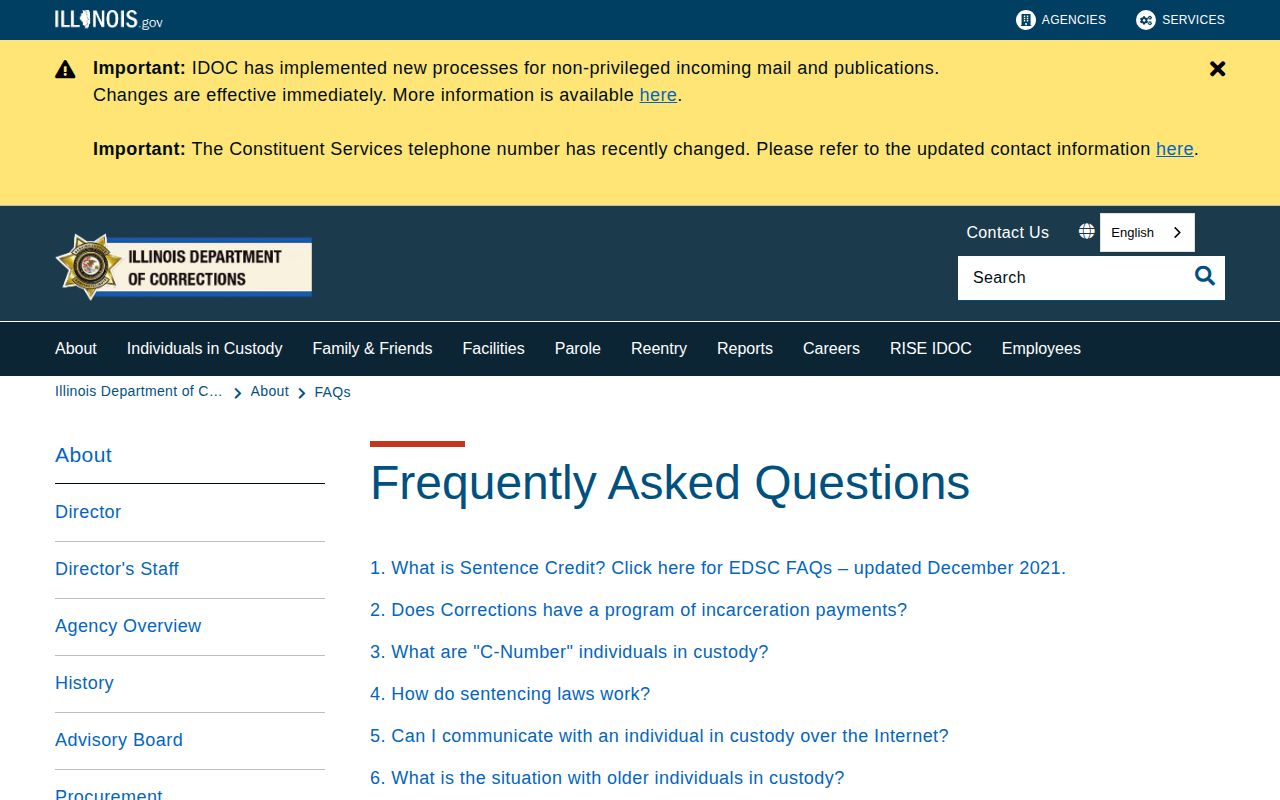
The image supports the need for an archive request after discharge; it is not a person-level result.
- Open the IDOC contact form and select Record Search under General Subject.
- Provide full name, date of birth, IDOC number, year received, facility, conviction county, relevant dates, and alternate spellings.
- Request limited fields: commitment, facility history, actual prison release, release type, parole or MSR start, and actual or projected discharge.
- State that the archived route is needed because the sentence may be complete.
IDOC Projected Release Dates
A projected MSR or parole date estimates departure from prison confinement. A projected discharge date estimates the end of sentence jurisdiction. An actual release or parole date records an event that occurred. Those three dates should never be merged.
Calculations can change after court amendments, credit audits, earned or revoked credit, new or consecutive sentences, warrants, detainers, revocation, time tolling, or release-plan review. Illinois sentence-credit law uses different structures based on offense, offense date, and sentence. Some categories require 100 percent service; listed serious offenses can have 85-percent or 75-percent structures. Those summaries do not replace the precise statute and sentence record.
1000 E. Converse Ave.
P.O. Box 19277
Springfield, IL 62794-9277
217-558-2200
DOC.EDSCInquiries@Illinois.gov
IDOC publishes weekday office hours of 8:00 a.m. to 4:00 p.m. and asks users to allow 48 business hours for response. The office can explain the agency calculation but cannot alter a judgment entered by the court.
IDOC Release Record Owners
Several offices may hold related records. IDOC maintains prison admission, facility, sentence, release, parole/MSR, and discharge data. The Illinois Prisoner Review Board sets conditions, decides alleged violations, handles certain parole hearings, and considers early final discharge. The Hardin County court keeps the sentence and commitment orders.
- Parole
- Community supervision used in designated Illinois sentence structures.
- MSR
- Mandatory supervised release after many determinate prison sentences.
- Revocation
- A formal decision that can return a releasee to custody after a violation process.
- Final discharge
- The end of state sentence jurisdiction.
A PRB hearing or grant does not by itself prove the physical date prison staff completed release. Pair the board action with the IDOC event. Likewise, a projected date is not a final event record. The Hardin County released inmate search can connect the initial county transfer to the state timeline.
Hardin Commitments to IDOC
The strongest bridge from Hardin County to IDOC is a custody timeline. Start with the Hardin booking number and admission. Add the sentencing and mittimus entry, the sheriff's transfer time and destination, the IDOC admission, later prison release or MSR start, and final discharge. Label any gap unconfirmed.
A person who served a short local sentence may never have an IDOC profile. Conversely, a Hardin prosecution can create an IDOC record even though no state prison sits within the county. The committing county or offense case helps connect the state record to Hardin.
The Former Hardin County Work Camp must not be confused with a current prison. It is inactive, and historical records belong with IDOC archives. Old facility references can be useful search terms, but they do not establish present custody or a current release channel.
A live profile is a status snapshot, not a certified full history. Preserve every date label and sentence flag, then request the agency record when an exact release method or destination is needed. VINE can add a second status source, but it does not replace IDOC's master record. The Hardin court establishes the sentence, IDOC records prison execution, and PRB records its own board actions.
IDOC Archive Matching
IDOC archive requests work best with full name, birth date, IDOC number, year received, institution, conviction county, relevant custody dates, and alternate spellings. Ask for actual release date and type separately from projected dates. If a final-discharge order matters, identify the issuing office and date. A state record naming Hardin as the committing county links the prosecution to Illinois custody, but does not make the county jail the keeper of the later prison release.
Compare the archived response with the sentencing order and sheriff transfer record. Keep each agency label intact. A mismatch may reflect a legal order date, physical movement date, or later data entry rather than an error.