
Former Work Camp Release Records
The Former Hardin County Work Camp is not a current release source. The Illinois State Fire Marshal identifies the Cave-In-Rock site as former and inactive. Older search results may preserve its name, address, or legislative history, but those traces do not show that IDOC still confines people there.
A person once housed at the work camp may have left through community release, parole or mandatory supervised release, final discharge, or transfer to another IDOC institution. Those outcomes are not interchangeable. A transfer keeps the person in state custody. Release from confinement to supervision ends the prison stay but not the whole sentence. Final discharge ends the remaining IDOC jurisdiction when the governing sentence and supervision are complete.
| Historical event | Meaning | Record owner |
|---|---|---|
| Institutional transfer | Custody continued at another IDOC site | IDOC master record |
| Parole or MSR | Prison confinement ended; supervision continued | IDOC and PRB records |
| Final discharge | Sentence jurisdiction ended | IDOC archive or PRB order |
| Local detention | A separate county custody event | Relevant sheriff and court |
Confirm Former Work Camp Status
The State Fire Marshal facility record supplies official evidence that the former work-camp site is inactive.
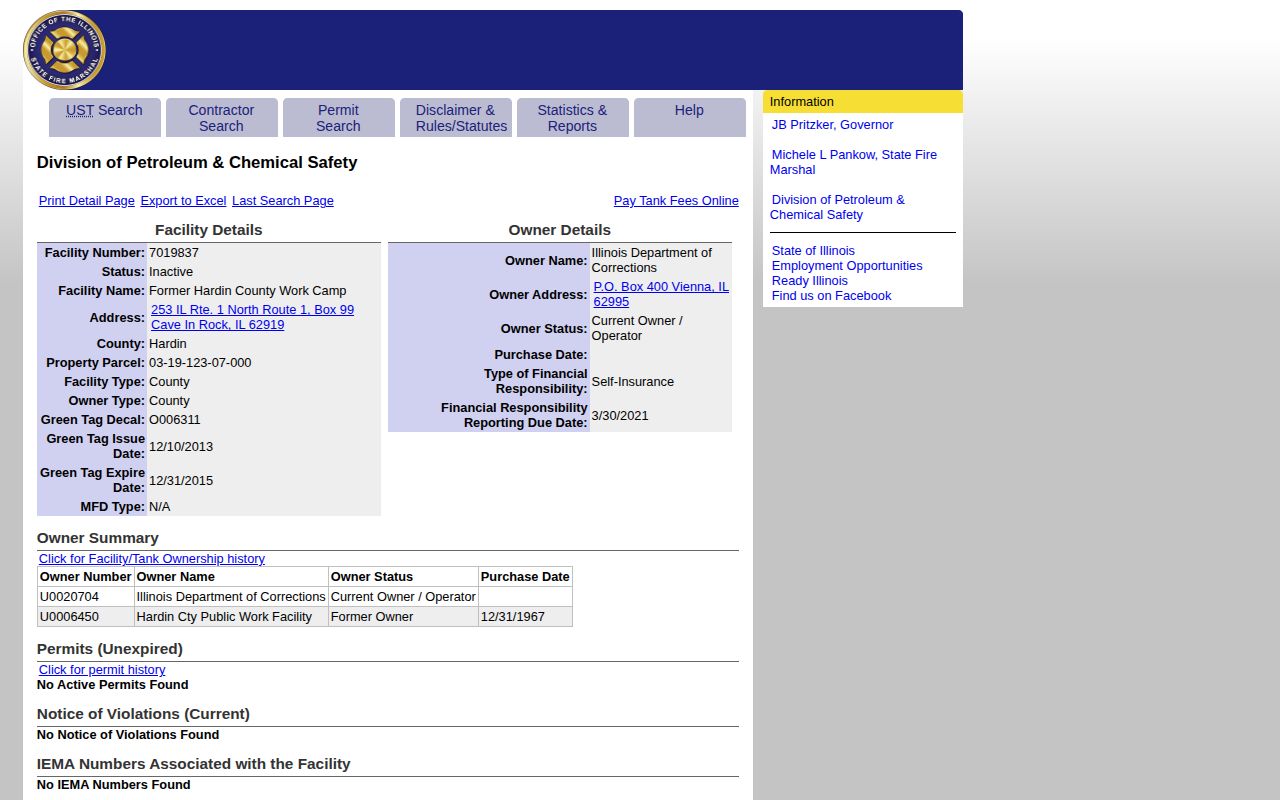
The captured record establishes the site's former status. It does not identify a person's release date or replace an IDOC custody record.
Legislative history connected to HB 4326 and the 2015 closure record help explain why older pages still appear. They offer institutional context, not a person-level lookup. A search result that repeats the work-camp name without a current state status should be treated as historical until an official source says otherwise.
Search Historical IDOC Releases
IDOC says its public Individual in Custody Search is limited to people who are currently incarcerated or on parole. Someone who completed the whole sentence may no longer appear. That rule makes a no-result outcome common in older work-camp research and makes the archived-record route essential.
- Gather the full legal name, date of birth, IDOC number if known, approximate admission and departure years, county of conviction, and alternate spellings.
- Check the current IDOC search only to learn whether the person remains incarcerated or on parole/MSR. Compare identifiers, not name alone.
- Use IDOC's contact form and select “Record Search” under General Subject when the sentence appears complete or the public profile is absent.
- Name the Former Hardin County Work Camp and request facility history, admission, transfer, actual prison release, parole or MSR start, and final discharge fields.
- If the record names a receiving prison, continue with that institution's history. If it names community supervision, identify the parole district and any PRB final-discharge record.
The IDOC facilities statewide page explains how live IDOC labels differ from archived records. For a historical work-camp case, preserve the date searched and the exact response because state records can distinguish transfer, prison release, and final discharge.
Former Work Camp Record Fields
A focused archive request should ask for enough information to build a custody timeline. Broad demands for an entire master file can pull in protected or irrelevant material. Event fields usually answer the historical release question more directly.
| Field | Question answered |
|---|---|
| IDOC number | Which state record matches the person? |
| Admission or commitment | When and under which case did custody begin? |
| Facility history | When was the person at the work camp? |
| Transfer destination | Where did custody continue? |
| Actual release and type | When did prison confinement end? |
| Parole/MSR and discharge | When did supervision begin and jurisdiction end? |
IDOC's FAQ indicates that public information about a current or former person can include name, IDOC number, parent institution, current location or status, vital statistics, admission and release dates, and sentencing information. Other master-file material may remain confidential unless disclosure is lawfully required. Ask for electronic records and allow the agency to redact exempt parts.
Work Camp Transfers at Closure
The closure history described proposed movement to other IDOC institutions, not an automatic local release. This difference is central. A person who left Cave-In-Rock for another prison had changed location but remained in government custody.
No one receiving prison should be assumed. IDOC placement can depend on sentence, classification, capacity, health, program needs, and agency authority. Geographic closeness is weak evidence. The master record's facility history or transfer entry should identify where the person went and when.
- Parent institution
- The institution tied to an IDOC profile; it may not describe a current home address.
- Transfer
- Movement between custodians or institutions without community release.
- MSR
- Mandatory supervised release following many determinate Illinois prison terms.
- Discharge
- The end of the sentence or legal jurisdiction, not merely a move out of one building.
If a historical newspaper item says inmates “left” the work camp, seek the underlying state record before assigning a release type. Ordinary words often hide the legal and custodial distinction.
Hardin's Two Facility Histories
Hardin County combines a county jail built in 1940 with the residue of an inactive state work camp. That distinctive footprint causes old and current facilities to appear side by side in search results. They had different operators, populations, records, and release paths.
The sheriff operates the local jail. IDOC operated the former work camp. A Hardin County Jail release record comes from the sheriff, while a work-camp custody history belongs with IDOC. The county jail should not be asked to recreate state prison movements, and IDOC should not be treated as the keeper of every short local jail release.
| Facility | Present status | Correct record path |
|---|---|---|
| Hardin County Jail | County detention facility | Sheriff release or transfer record |
| Former Hardin County Work Camp | Inactive historical IDOC site | IDOC archive and receiving institution history |
This split also prevents a false link between the place name and prosecuting county. An IDOC placement in Cave-In-Rock did not by itself mean that Hardin County prosecuted the case.
Contact IDOC Record Search
The inactive property has no verified present release desk. IDOC's central record route is the right starting point for a person-level history. Use the state contact form, choose Record Search, and provide enough identifiers to locate the record without attaching unrelated private material.
Online contact form: choose Record Search
Public information line: 217-558-2200
Use full name, birth date, IDOC number, years, facility, and conviction county.
For sentence-credit or projected-date questions, IDOC lists Constituent Services at 1000 E. Converse Ave., P.O. Box 19277, Springfield, IL 62794-9277, and DOC.EDSCInquiries@Illinois.gov. Those channels can explain a calculation but cannot rewrite the sentencing judgment. Published office hours are weekdays from 8:00 a.m. to 4:00 p.m., with a request to allow 48 business hours for response.
For board action, such as an early final discharge, the Illinois Prisoner Review Board may hold the separate record. An IDOC release date, a PRB order, and a court sentence can describe different stages. Keep all dates labeled.