
Federal Release Paths from Hardin
A person can pass through a local jail under federal authority and later enter U.S. Marshals or BOP custody. The Hardin County departure record should name the receiving agency. “Released by Hardin” can mean delivery to the Marshals, not entry into the community.
BOP confinement starts only after the federal process reaches that system. A person may spend time in a contract jail or USMS hold before designation. Later release from BOP can lead to the community, a residential setting, another detainer, or federal supervised release. Each event needs its own source.
| Event | Meaning | Source |
|---|---|---|
| Hardin to USMS | Federal custody continues | Jail transfer line and federal docket |
| BOP incarcerated | Held by federal prisons | BOP Inmate Locator |
| BOP released | BOP confinement ended | Locator, release notice, or BOP record |
| Supervised release | Federal court supervision continues | Judgment and U.S. Probation |
Search BOP Federal Releases
The BOP Inmate Locator covers federal inmates from 1982 to the present. Search by register number when known. The name search also uses age, race, and sex. Compare identifiers because a name alone can produce the wrong person.
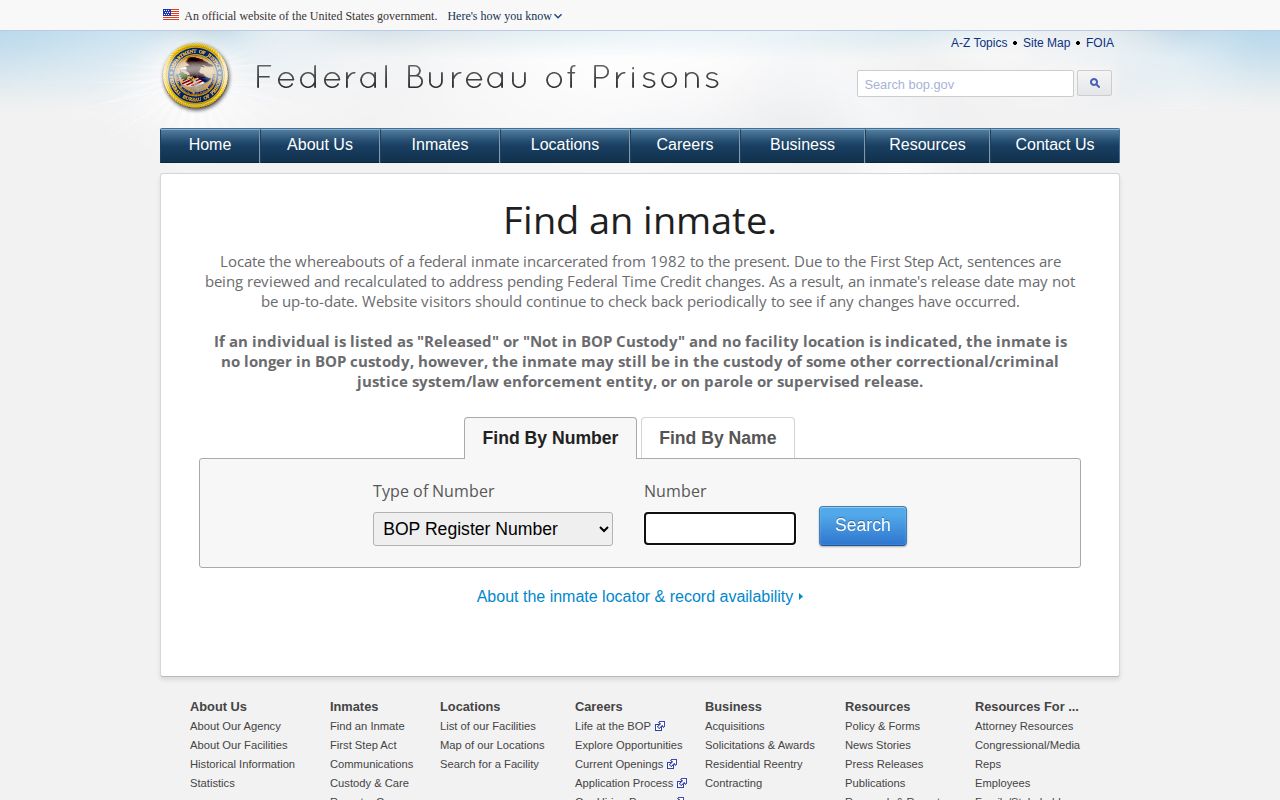
The official locator image shows the correct federal entry point. It is not a county release feed or proof of a local Hardin event.
- Enter the BOP register number for the strongest match, or use the biographical search.
- Confirm name, register number, age, race, and sex against the federal case.
- Read the exact status, location, and release-date fields.
- Save the result with the search date because federal calculations may change.
- Use the federal docket and BOP records when the release method, destination, or supervision term matters.
Read Federal Release Results
A former federal prisoner's locator result can state “Released” and display a release date. “Not in BOP custody” is broader. It can mean release, another custodian, a non-BOP placement, or a situation outside locator coverage. Neither phrase describes a Hardin County Jail release.
| BOP field | Use |
|---|---|
| Name and register number | Match the person and federal record |
| Age, race, and sex | Reduce same-name errors |
| Location | Identify current or last reported BOP setting |
| Release date | Recorded or calculated BOP event date |
BOP cautions that dates can change as First Step Act and other sentence calculations are updated. A projected or displayed date should be checked again near the event. The federal judgment can also show the custodial term and supervised-release term, but it does not record the exact moment staff completed release.
Federal Release Record Detail
BOP's BP-A0714 Notice of Release and Arrival can be more informative when lawfully available. It may distinguish the release method, releasing institution, community release versus detainer release, supervision, and a reporting instruction. Request only records needed to establish the custody event.
For older or more detailed histories, use BOP FOIA or the National Archives where applicable. Include the person's full name, register number, dates, institution if known, and the exact admission, transfer, release, or destination fields sought.
- Register number
- The federal identifier used to match a BOP record.
- Detainer release
- BOP custody ends while another authority takes custody.
- Supervised release
- A federal court supervision term after confinement.
- Final sentence end
- The conclusion of all terms, not merely prison departure.
A BOP release statistic may exclude certain transfers to other custodial jurisdictions. That system-specific definition reinforces the need to ask where the person went.
USMS Transfer Records
The U.S. Marshals Service transports and temporarily houses federal detainees, often through contract arrangements. It does not publish a county-style historical roster. A person can be in federal custody without yet appearing as a designated BOP prisoner.
Use the federal criminal docket and clerk's detention, release, or commitment order first. Then contact the relevant Marshals district or submit a focused USMS FOIA request for custody dates and transfer disposition. Public guidance indicates that personal histories, prisoner photographs, and exact arrival or departure times are generally restricted, so a telephone call should not be presented as a guaranteed record source.
After sentencing, a USMS transfer to BOP continues custody. Before trial, a judge's federal release order may authorize community release, but execution and any other hold still need confirmation. Keep the order and physical custody event separate.
Federal Facilities and Hardin County
No BOP prison or official USMS detention center in Hardin County was found. Federal tools are conditional paths triggered by a Hardin release record, a federal case, or another agency document. They are not the default way to check a local booking.
If the Hardin jail says the person went to IDOC, use the Illinois state system. If it says ICE, use immigration custody channels. If it says USMS or BOP, use the federal criminal path. The Hardin County release search explains how to obtain the local bridge record before switching systems.
BOP Inmate Locator: current and released BOP results
BOP FOIA: detailed or archived federal prison records
USMS FOIA: focused transport or custody requests
Federal court clerk: detention, judgment, and release orders
Build a dated timeline from local admission through federal transfer, BOP admission, release method, destination, supervision start, and final sentence end. Leave gaps marked unconfirmed. Similar names across county and federal systems are not enough to join two records.
Federal Release Versus Freedom
Federal custody language is system-specific. BOP can release a person to another authority. USMS can deliver a person to BOP. A local jail can transfer a federal detainee. Each agency may accurately say the person left its custody even though confinement continued.
The most reliable record states the releasing custodian, date, method, destination, and receiving authority. A court order adds the legal basis. When supervised release follows, the person is in the community but still subject to a federal court term administered through U.S. Probation.
Do not use an Illinois VINE or IDOC result as a substitute for BOP records. VINE is not the federal locator, and IDOC covers Illinois corrections rather than federal sentences. Likewise, a BOP result cannot resolve an unrelated Hardin County case.
A focused BOP archive request should identify the register number, conviction court, likely institution, and date range. Ask for admission, facility history, actual release date, release method, detainer destination, and the Notice of Release and Arrival when releasable. For a pre-BOP period, seek the federal detention order and USMS transfer disposition. For the period after prison, preserve the judgment's supervised-release term and the public federal docket.
Older custody before the locator's 1982 coverage may require the National Archives. Note every office contacted, identifier used, and response date. When two official sources differ, retain both labels and ask the record owner to explain the gap instead of choosing one date without support.
Match Federal Release Evidence
The federal criminal docket can preserve an order long after a temporary holding location changes. Read detention and release orders, the judgment, sentence amendments, and supervised-release entries in sequence. The clerk record explains legal authority, while BOP or USMS records establish physical custody. Tie a locator release date to the matching register number and federal case.
If the local Hardin record names only “federal,” ask which agency received the person before choosing BOP, USMS, or ICE. Preserve the handoff time, destination, and the next agency admission. This prevents an agency-specific departure from being mislabeled as community release.